

Durability Is the Real Advantage
Why durability matters more than intensity

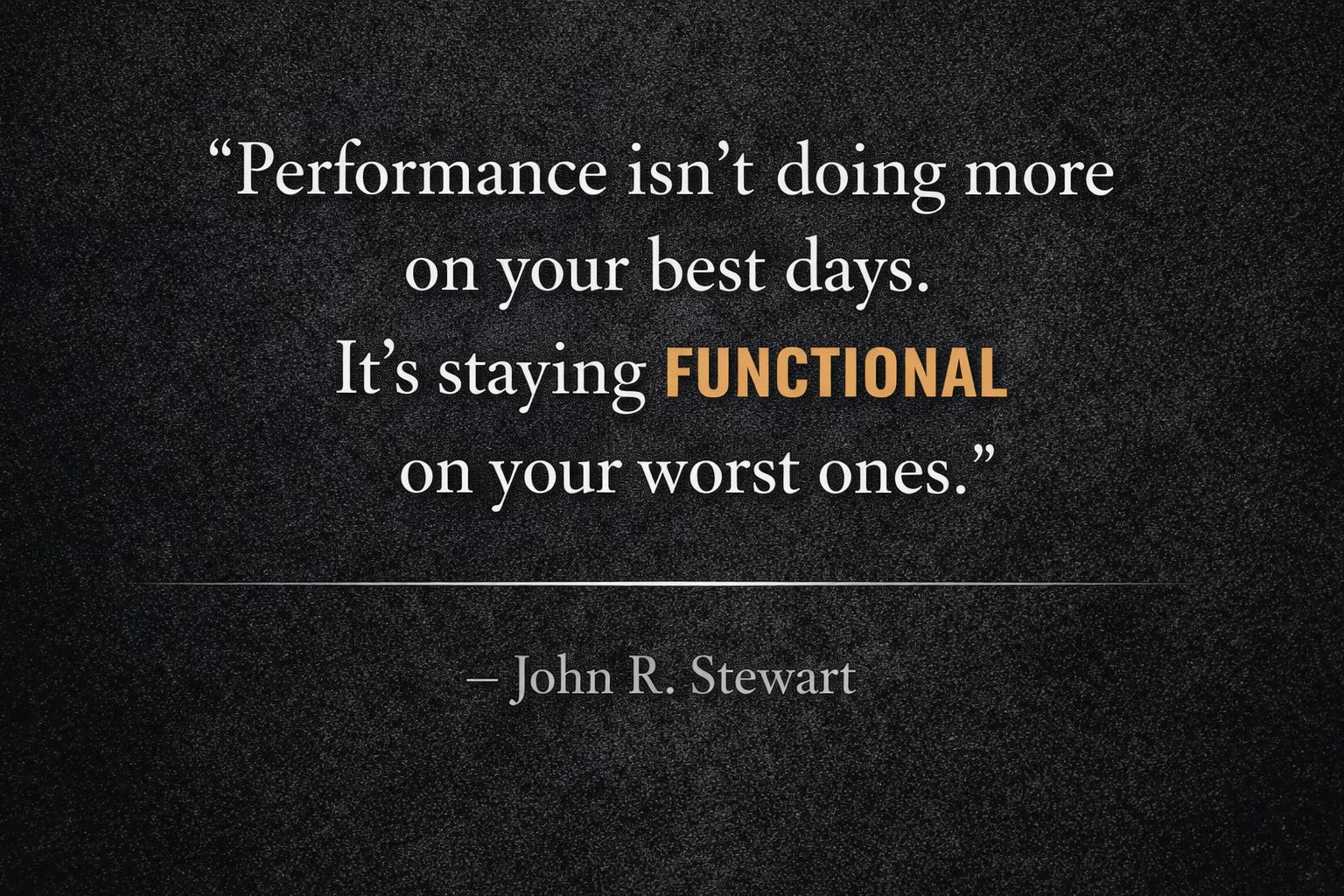
Most people misunderstand what performance actually is.
They picture intensity. Momentum. Breakthroughs. Long stretches of focus where everything clicks and effort feels almost effortless. They assume the goal is to maximize output during those moments and that success belongs to the people who can summon that state more often than others.
That belief is seductive. It feels productive. It feels earned.
It’s also fragile.
Because life doesn’t test you on your best days.
It tests you when you’re tired. When you’re distracted. When something breaks. When your sleep is off, your mood is flat, your schedule is full, and the conditions you designed your system around no longer exist.
And that’s where most systems quietly fail.
Intensity Works—Until It Doesn’t
Intensity gets a lot of credit because it creates visible change fast.
You feel locked in. Motivated. Clear. The friction drops away and you start executing at a level that feels like proof of who you really are. It’s intoxicating because it creates a story: This is the version of me I’ve been trying to access.
For a while, it works.
But intensity depends on conditions. It assumes energy. It assumes focus. It assumes emotional bandwidth. It assumes a nervous system that isn’t already carrying debt.
Life doesn’t care about those assumptions.
Eventually, something interrupts the rhythm. A bad night of sleep. A sick kid. Travel. Stress at work. A stretch where progress slows and novelty fades. Nothing dramatic. Nothing worth calling a crisis. Just enough disruption to expose the truth.
The system only worked when you were at your best.
How Systems Actually Break
Most systems don’t collapse in a single moment. They erode.
The workout gets skipped because recovery didn’t happen. The routine gets compressed because time feels tight. The habit you relied on becomes optional “just for today.” Then again tomorrow.
From the outside, nothing looks wrong. From the inside, the structure is thinning.
People don’t quit because they lack discipline. They quit because their systems don’t tolerate normal human variability. Fatigue. Stress. Emotion. Boredom. Competing priorities.
When those show up, the system doesn’t bend. It snaps.
And when it snaps, people blame themselves instead of the design.
Why Stability Is Underrated
Stability doesn’t look impressive.
It doesn’t create spikes. It doesn’t generate dramatic before-and-after stories. It doesn’t feel like momentum. It feels boring. Conservative. Almost cautious.
But stability does something intensity can’t.
It survives.
Stable systems assume bad days. They expect inconsistency. They build in margin instead of demanding perfection. They don’t require you to feel a certain way to function.
They’re not optimized for output at peak energy. They’re optimized for continuity under pressure.
That’s the real advantage.
Performance Under Constraint
Anyone can perform when conditions are ideal.
The question that matters is simpler and more uncomfortable:
What still runs when things aren’t?
When sleep is compromised. When motivation is absent. When attention is fractured. When life adds weight instead of removing it.
Most people design systems for who they want to be on their best days. Very few design systems for who they actually are across an average week.
That gap explains most inconsistency.
It’s not a character issue. It’s an engineering problem.
The Myth of “Getting Back on Track”
Pay attention to how often people say they need to “get back on track.”
That phrase is revealing.
It implies that the system only works under narrow conditions—and that falling off is expected. It frames collapse as a temporary deviation instead of a predictable outcome of poor design.
A good system doesn’t require resets.
It absorbs disruption and keeps going, even at reduced capacity. It allows partial execution without guilt. It prioritizes continuity over optimization.
If you’re constantly restarting, relaunching, or rebuilding momentum, the problem isn’t effort.
It’s fragility.
Durability Beats Output
Durability isn’t exciting. It doesn’t reward you with dopamine hits or identity boosts. It doesn’t give you the satisfaction of “going all in.”
What it gives you instead is time.
Time without collapse. Time without recovery spirals. Time without rebuilding from scratch.
Over long horizons, that wins.
Not because you did more in any single moment, but because you stayed operational when others disappeared.
What This Reframes
This isn’t an argument against ambition.
It’s an argument against systems that only function when ambition is high.
True performance isn’t about pushing harder. It’s about designing structures that don’t require pushing at all—structures that keep working when you’re tired, distracted, or discouraged.
Most people don’t need more motivation.
They need fewer points of failure.
Final Thought
Performance isn’t a highlight reel.
It’s quiet continuity.
It’s what still functions when energy drops, when life interferes, and when the conditions you planned for no longer exist.
If your system only works when you’re at your best, it isn’t a system.
It’s a gamble.
And over time, life always collects.
Performance Protocol is a system-first approach to human performance — built on physiology, recovery, and real-world constraints.
Each article is a layer in the same framework.
No hacks. No hype. Just structure.