

When Systems Meet Reality
Why protocols exist at all

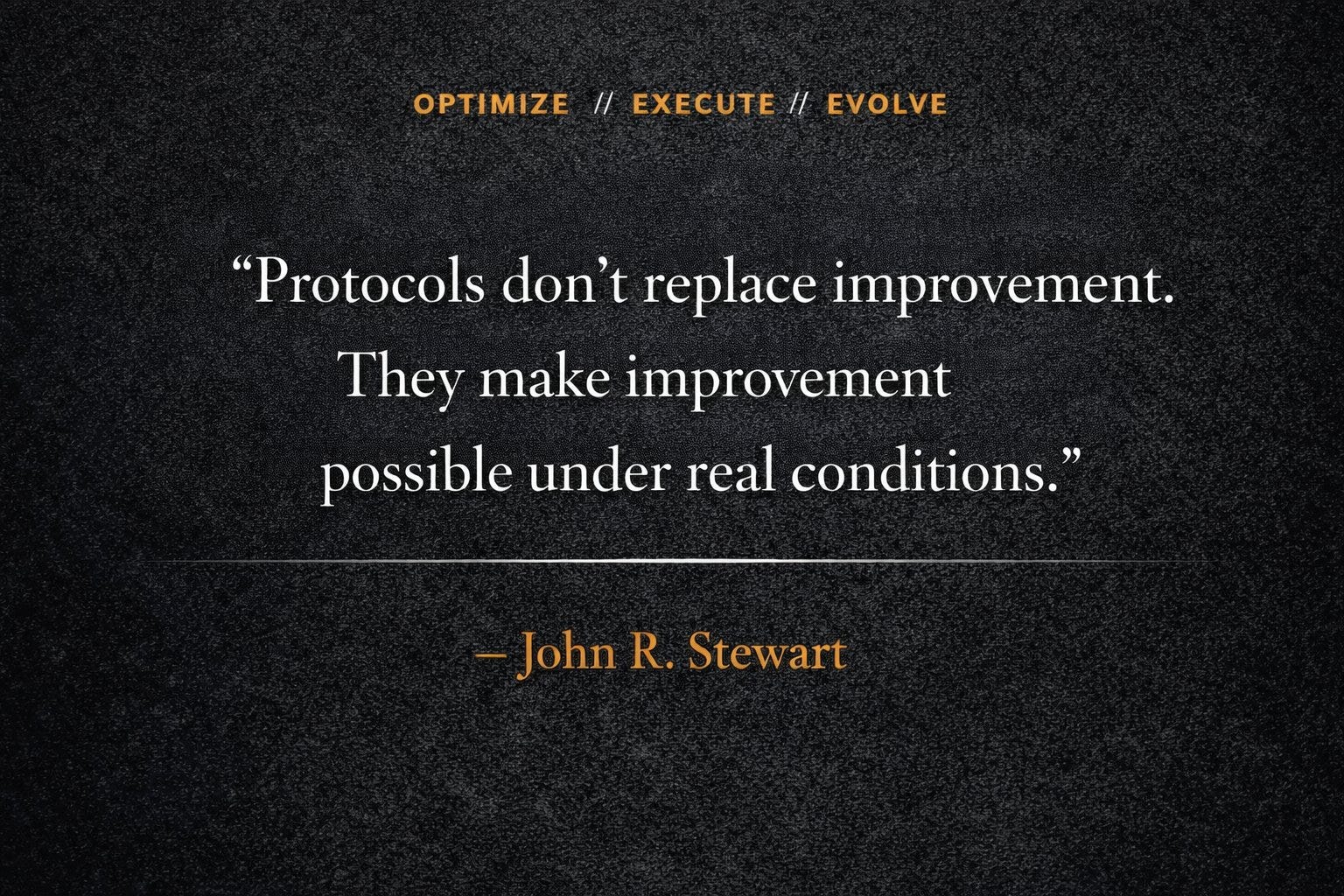
Most advice works in theory.
It assumes time.
It assumes energy.
It assumes a version of you that is calm, well-rested, motivated, and uninterrupted.
That version of you exists occasionally.
Life does not.
Most people don’t fail because they don’t understand what to do. They fail because reality interferes with execution. Stress compresses time. Fatigue distorts judgment. Emotion overrides intention. And the conditions required for “good habits” quietly disappear.
This isn’t a motivation problem.
It’s a design problem.
When Good Systems Break
We like the idea of systems because they promise consistency without effort. Set it up once. Let it run. Improve over time.
But most systems are built for ideal conditions.
They assume:
stable schedules
predictable energy
uninterrupted focus
emotional neutrality
Those assumptions don’t survive contact with real life.
What breaks systems isn’t chaos. It’s normal variability. A bad night of sleep. A stressful conversation. A week that runs long. A season where attention is fragmented and recovery is incomplete.
Nothing dramatic. Nothing worth a reset. Just enough friction to expose fragility.
When that happens, people blame themselves instead of the structure.
Where I’ve Seen This Firsthand
The periods where things worked best for me were not the periods where I was most motivated.
They were the periods where I committed fully to a small number of protocols and stopped negotiating with them.
Sleep protected.
Training simplified.
Inputs controlled.
Decisions reduced.
Not optimized. Protected.
And the opposite was also true.
The moments where things unraveled weren’t because I didn’t know what to do. They were moments where I treated structure as optional. Where I allowed “just this once” exceptions to accumulate. Where I relied on judgment instead of design.
Nothing failed all at once.
The system just quietly degraded until it couldn’t carry normal life anymore.
That pattern repeats far more often than people admit.
Why Advice Keeps Failing
Advice usually answers the wrong question.
It tells you what to do when things are going well.
Eat better.
Train consistently.
Focus deeply.
Be disciplined.
None of that is incorrect. It’s just incomplete.
The more important question is rarely asked:
What still works when things aren’t?
When energy is low. When stress is high. When the day goes sideways before noon. When discipline feels theoretical instead of available.
Advice collapses under those conditions because it isn’t built for constraint.
The Difference Between Habits and Protocols
Habits assume repetition under stable conditions.
Protocols assume disruption.
A habit asks you to show up the same way every day.
A protocol asks what still runs when you can’t.
Protocols don’t optimize for performance at your peak.
They protect function at your floor.
They are not aspirational. They are defensive by design.
That’s why they feel less exciting — and why they last.
Why Motivation and Willpower Aren’t Enough
Motivation is volatile. Willpower is finite. Both degrade under stress.
That’s not a personal failure. It’s biology.
Under pressure, the nervous system prioritizes survival over optimization. Decision-making narrows. Cognitive load increases. The capacity to “push through” drops precisely when people expect it to rise.
Protocols work because they don’t fight that reality.
They remove decisions instead of demanding better ones. They reduce friction instead of requiring strength. They assume you will not feel ready — and function anyway.
Commitment Is the Difference
The protocols that worked for me weren’t clever.
They were boring. Clear. Non-negotiable.
And the times they failed weren’t because the protocol was wrong. They failed when I treated them as suggestions instead of constraints.
Protocols only work when they’re commitments, not preferences.
Once they become optional, they’re just ideas again.
Where This Is Going
This is the line between talking about performance and operating with it.
From here forward, Performance Protocol isn’t about better ideas. It’s about structures that survive real life.
Some of those will live here — as framing, context, and explanation.
The protocols themselves will live where they can be used, adjusted, and evolved.
Because insight without execution is entertainment.
And execution without structure is luck.
Final Thought
A protocol isn’t self-improvement.
It’s what allows you to keep functioning when improvement isn’t the priority.
When systems meet reality, only one thing matters:
Does it still run?
That’s what comes next.
Performance Protocol is a system-first approach to human performance — built on physiology, recovery, and real-world constraints.
Each article is a layer in the same framework.
No hacks. No hype. Just structure.